




Geometry-aware video world models

UPCAST.

Factorized world transitions for geometry-aware video generation.

Learn structure and appearance together; generate with the video backbone alone.

REAL ESTATE10K · 64-FRAME GENERATED ROLLOUTCAMERA-CONDITIONED VIDEO
497.864-frame FVD ↓vs. 534.9 Geometry Forcing
3.88JEDi ↓vs. 4.40 Geometry Forcing
64frames4× training clip length
13.94PSNR ↑vs. 12.44 Geometry Forcing

Research overview

Inside UPCAST.

From complementary visual evidence to factorized transitions and a standalone video backbone.

01 / The idea

Geometry is not the whole visual state.

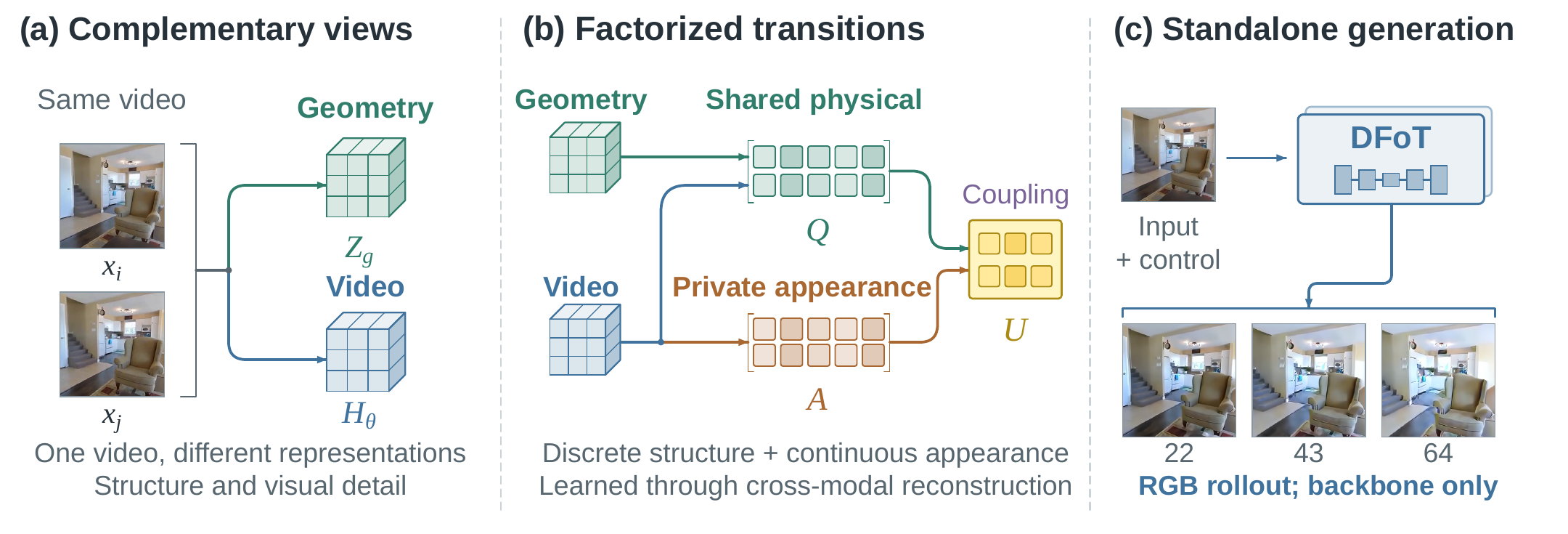
Geometry describes structure; the future frame also needs appearance. UPCAST learns the two roles in a predictive transition and transfers their benefit into a standalone video model.

GUIDED WALKTHROUGH 01 / 03
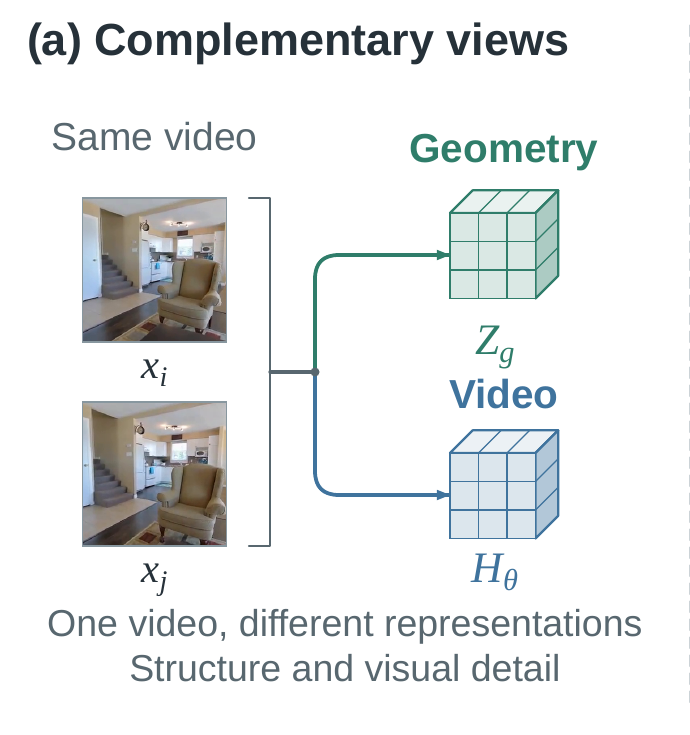
The same video provides geometric and visual representations.
01 / THE OBSERVATION

One video, complementary evidence.

A geometric representation can preserve layout and correspondence, but it cannot alone specify the scene's color, texture, and lighting.

Same observation · different predictive roles
Complete paper overview: complementary views, factorized transition, and standalone generation.
THE COMPLETE OVERVIEW

02 / Generated videos

Follow the same camera path.

Reference and generated videos share the initial frame and camera trajectory. Generated methods use matched sampling seeds across distinct indoor layouts.

ReferenceGround truth
UPCASTOurs
Geometry ForcingBaseline
FRAME 01 / 64 8.0 S

Across the rollout

Visual fidelity over 64 frames.

Frame-wise PSNR from cohort-mean RGB error across 100 matched videos; the conditioning frame is excluded.

Stairwell rollout at frame 2
02
Stairwell rollout at frame 16
16
Stairwell rollout at frame 32
32
Stairwell rollout at frame 48
48
Stairwell rollout at frame 64
64
UPCAST Geometry ForcingHigher is better ↑

03 / How it works

Learn together. Generate alone.

The physical and appearance states are training-time representations. Their predictive benefit is transferred into the original video backbone.

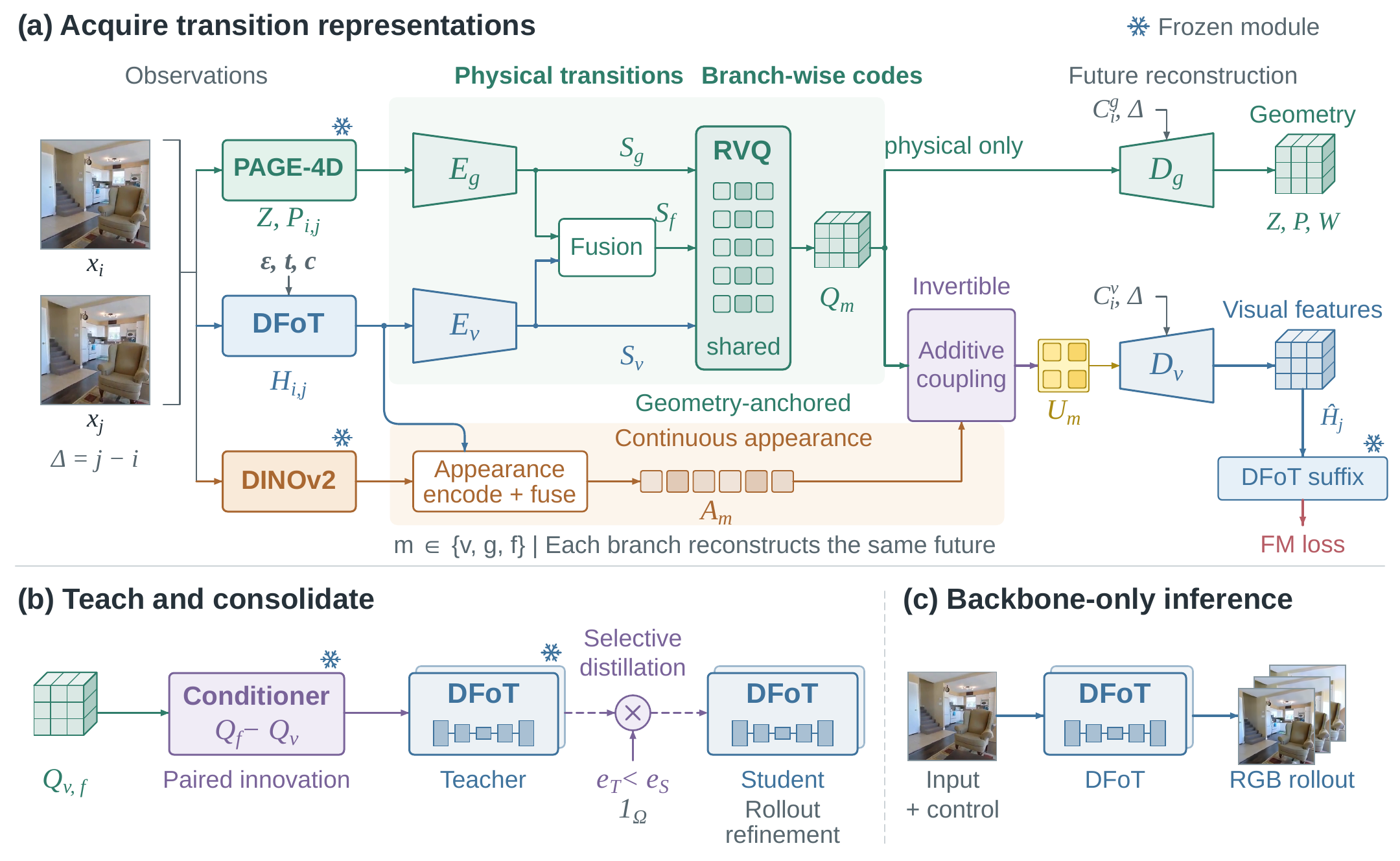
Complete method: factorized transition learning, selective knowledge transfer, and backbone-only inference.
THE COMPLETE METHOD
METHOD WALKTHROUGH 01 / 03
PAIRWISE TRAINING

Separate what stays shared from what remains visual.

The same frame pair reaches the video and geometry-semantic branches. All three branches reconstruct the future.


Earlier reference stairwell frame
xi
Later reference stairwell frame
xj
Same frame pairVideo + camera controls
SHARED PHYSICAL
DFoT + PAGE-4DShared RVQQ

Geometry anchors a common discrete transition vocabulary.

PRIVATE APPEARANCE
DFoT + DINOv2Continuous encoderA

Texture, illumination, and semantic detail bypass quantization.

ADDITIVE COUPLING
QA
UVisual futureGeometry future reads Q only
FROZEN SIGNALS DURING TRAINING

PAGE-4D provides geometry features and point maps that anchor the shared physical vocabulary.
04 / Geometry under domain shift

Structure, beyond the training domain.

Matched ARKitScenes views pair generated RGB with sensor depth. The same frozen estimator reconstructs depth from each generated sequence.

UPCAST estimated-depth relative errorGeometry Forcing estimated-depth relative errorUPCASTGeometry Forcing
FRAME 17 / 6464 FRAMES
0% relative error≥50%
Reference ARKitScenes frame 17
Reference RGB
Sensor depth at frame 17
Sensor depth
UPCAST depth error at frame 17
UPCAST
Geometry Forcing depth error at frame 17
Geometry Forcing
SELECTED SCENE · 64 FRAMES

Tiled doorway

Depth AbsRel ↓0.170 / 0.245
F@10 cm ↑0.631 / 0.500

The floor and door boundaries retain more of the sensor-referenced layout. Values compare UPCAST / Geometry Forcing on this clip.

Across the 12 matched clips

Zero-shot · 64 frames · conditioning frame excluded

Depth AbsRel ↓0.194 / 0.216
F@10 cm ↑0.627 / 0.621
Chamfer-L1 ↓0.105 / 0.101
Pose R@10 ↑0.265 / 0.317

UPCAST / Geometry Forcing. Depth and point-cloud recall favor UPCAST; Chamfer and pose favor Geometry Forcing. Estimated depth is clip-scale aligned to the sensor.

Complete sensor-referenced metrics
MethodPSNR ↑AbsRel ↓δ1 ↑Scale drift ↓Normal MAE ↓Chamfer-L1 ↓F@5 cm ↑F@10 cm ↑Pose R@10 ↑
Geometry Forcing11.850.2160.6700.17730.31°0.1010.4250.6210.317
UPCAST14.190.1940.6990.16029.13°0.1050.4390.6270.265

Depth comes from one frozen metric-indoor estimator and is aligned by one scale per clip. Pose R@10 uses 10 cm / 10° and counts PnP failures as misses.

05 / Main results

Measured on matched rollouts.

Camera-conditioned RealEstate10K evaluation with shared initial frames, camera trajectories, and sampling seeds.

64-frame RealEstate10K · UPCAST compared with Geometry Forcing

FVD ↓497.8 vs. 534.96.9% lower
JEDi ↓3.88 vs. 4.4011.8% lower
PSNR ↑13.94 vs. 12.44+1.50 dB
64-frame rollouts · 100 matched videos
MethodFVD ↓FID ↓LPIPS ↓SSIM ↑PSNR ↑JEDi ↓RPE ↓

RPE uses the first 12 primary-test videos; other columns use all 100.

06 / What changes

The gains survive the handoff.

One checkpoint lineage separates transition-space learning, backbone consolidation, and generated-history refinement. Every row is evaluated through the backbone alone.

TRAINING-STAGE ANALYSIS25 matched 64-frame rollouts
StageFVD ↓FID ↓LPIPS ↓SSIM ↑PSNR ↑JEDi ↓
Video backbone869.888.300.4140.50513.787.88
Unified-space learning674.474.690.3730.52214.226.59
Backbone consolidation708.978.180.3610.53414.296.05
Rollout refinement707.577.870.3610.53414.305.90
01
Learn a shared transition

Unified-space learning reduces FVD and JEDi before distillation.

02
Consolidate into DFoT

JEDi and visual fidelity improve, though FVD rises from the unified stage.

03
Adapt to generated history

Refinement further lowers JEDi without changing the inference path.

CHECKPOINT LINEAGE

Follow the handoff.

Unified-space learning improves FVD; the backbone-only handoff retains most of that gain.

Representations carry different predictive information.

On 192 held-out transitions, physical video-to-geometry retrieval is 13.54% Top-1 versus 0.52% chance. Private-state retrieval is 70.31% Top-1; removing private input raises frozen visual-decoder loss by 45.1%.

The transfer extends to action control.

On 100 matched Minecraft quickstart videos, Action-DFoT + UPCAST improves FVD from 245.0 to 221.7, PSNR from 15.83 to 15.97, and paired action response from 86.89% to 89.78%.

Complete action-conditioned results
MethodFVD ↓FID ↓LPIPS ↓SSIM ↑PSNR ↑Action BAcc. ↑Response ↑
Action-DFoT245.039.510.4310.52415.8385.10%86.89%
+ UPCAST221.737.550.4240.52815.9785.35%89.78%

DFoT Minecraft quickstart: 10 training and 10 validation trajectories, 100 matched 16-frame videos. Both variants use backbone-only inference.

Resources

Code, checkpoints & paper.

Code

Training, backbone-only generation, and evaluation implementations.

View on GitHub

Checkpoints

Trained video backbone and auxiliary transition modules.

Checkpoints pending

Paper

Learning Factorized World Transitions for Geometry-Aware Video World Models.

Paper release pending

07 / Models & data

What enters training and deployment.

UPCAST stands for Unified Physical and Complementary Appearance State Transitions. Frozen foundation features shape the training space; only the camera- or action-conditioned DFoT backbone remains at generation time.

TRAINING-TIME SIGNALS
PAGE-4D
Geometry features and point maps
DINOv2
Visual-semantic features
V-JEPA
Spatiotemporal predictive regularization
Shared RVQ + private path
Factorized transition learning
DEPLOYMENT & EVALUATION
DFoT
Standalone RGB rollout backbone
RealEstate10K
Camera-conditioned primary and long-horizon tests
ARKitScenes
Zero-shot sensor-referenced evaluation
Minecraft quickstart
Action-conditioned extension